

For a new sports brand or running brand developing its first hydration running vest, one of the first questions is often:
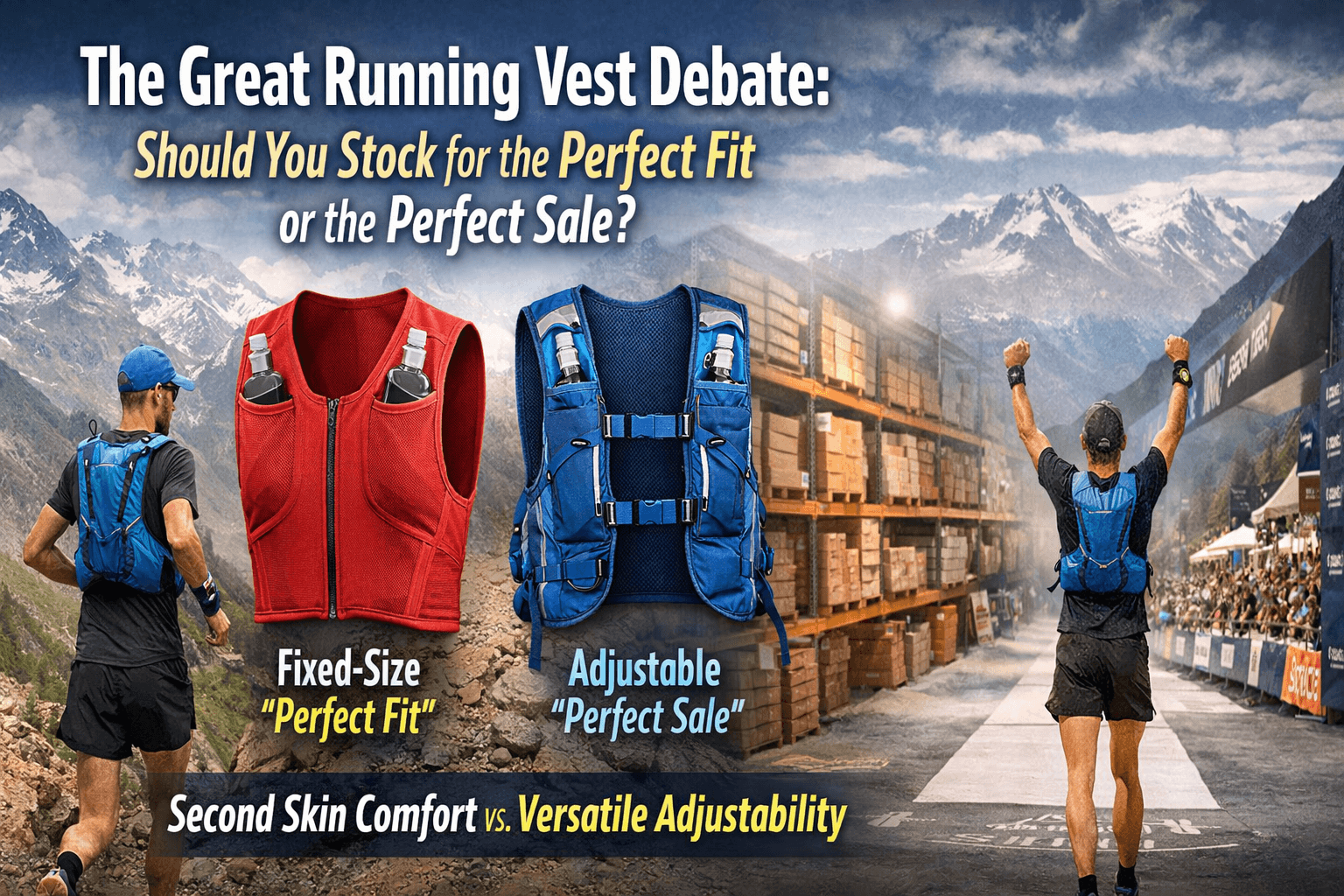
Should we start with an adjustable one-size design, or develop S, M, L and XL fixed sizes from the beginning?
From the outside, this may look like a simple sizing decision.
From a manufacturing and product-development point of view, however, it affects much more than fit.
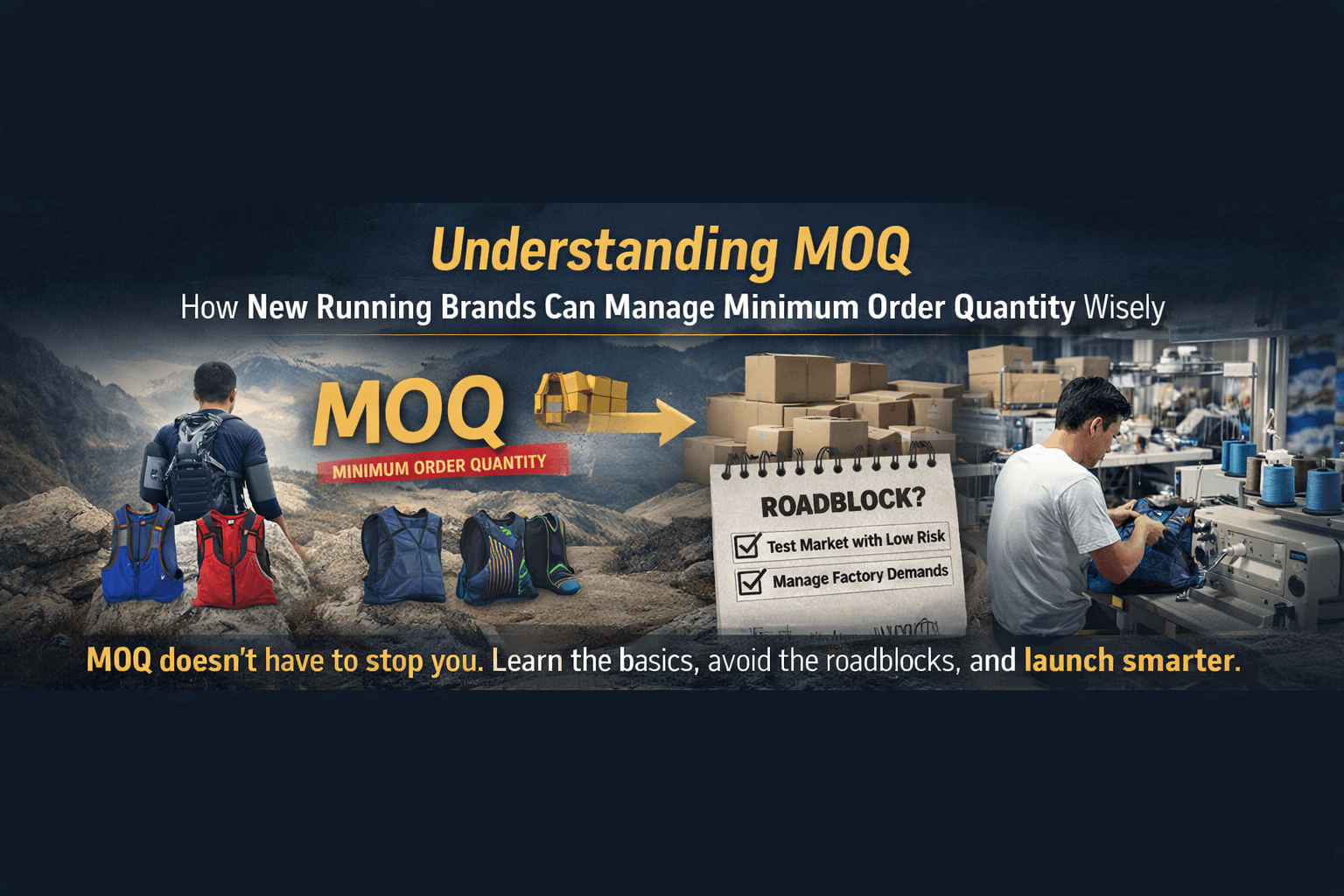
It affects your MOQ, number of SKUs, inventory investment, product testing, cash flow, development cost and even how quickly you can learn what your actual customers want.
At Quanzhou Jarler Bags Co, Ltd., we have worked on running vests, hydration packs and related OEM/ODM premium sports products for different markets. From a running vest factory point of view, we normally recommend that a new brand look at this decision from both the product side and the business side.
For many first launches, an adjustable side-strap design is a very practical direction.
It makes sense not only technically and from a product-development point of view, but also commercially, because it gives a new brand more flexibility in production, inventory management and market testing.
That does not mean fixed-size hydration vests are worse.
They simply solve a different problem.
Adjustable One-Size vs. Fixed-Size Hydration Running Vest: The Basic Difference
There are two common sizing directions when developing a running hydration vest.
1. Adjustable Side-Strap Design
An adjustable hydration running vest uses elastic straps, webbing, buckles, cords or other adjustment structures around the sides and chest so that one size can accommodate a wider range of body types.
The objective is not literally to fit every person.
The objective is to create enough adjustment range that the same SKU can serve a relatively broad customer group while still keeping the vest stable during running.
For a new brand, this structure can significantly simplify the first production.
2. Fixed-Size Performance Fit
A fixed-size vest is developed in sizes such as:
- S
- M
- L
- XL
Sometimes a brand may use XS–S, M–L and XL–XXL or another size grouping depending on its target market.
The pattern for each size is controlled more precisely around chest circumference, body length, shoulder position, armhole position and pocket placement.
When properly developed and tested, fixed sizing can provide a closer and more performance-focused fit.
This is particularly useful for technical trail running, long-distance running and customers who expect the vest to fit very closely to the body.
Why We Often Recommend an Adjustable One-Size Vest for a First Launch
Compared with fixed-size styles, an adjustable side-strap design with one size fitting a wider range of body types is generally a lower-risk option for a first product launch.
The main advantage is that you can reduce the number of SKUs and avoid holding too much inventory across different sizes.
This helps keep the initial investment, inventory level and cash flow more manageable, especially when you are still testing the market.
For many startup running brands, this commercial consideration is just as important as the physical product itself.
You may have a very good design, but during your first launch you still do not know exactly:
- which color will sell best;
- which size will sell fastest;
- which market segment will respond most strongly;
- whether customers prefer a 5L, 10L or 15L vest;
- how important soft-flask compatibility will be;
- what price customers are willing to pay;
- which pocket configuration they actually use most;
- whether they prefer road running, marathon or trail-running features.
Reducing the number of SKUs gives you more room to learn.
A Simple MOQ Example
Our regular MOQ is generally calculated by model / color / size, depending on the development project.
For example, assume our Jarler factory’s MOQ is:
200 pcs per model / color / size
If you would like to launch one design in three colors:
Adjustable One-Size Style
200 pcs × 3 colors
= 600 pcs total
Fixed-Size Style With S, M, L and XL
200 pcs × 3 colors × 4 sizes
= 2,400 pcs total
That difference can be very significant for a new running brand.
But the difference is not only the total quantity.
The Hidden Risk Is SKU Distribution
With four fixed sizes, you also need to decide how many pieces to produce in each size before you have actual sales data.
Even if the total demand for the product is good, the sales ratio between S, M, L and XL may be different from your original forecast.
For example, one size may sell very quickly while another size moves much more slowly.
You could therefore have a situation where:
- your best-selling size is sold out;
- customers are asking when it will be restocked;
- another size is still sitting in your warehouse;
- cash remains tied up in slow-moving inventory;
- you cannot simply convert the remaining stock into another size.
This is one of the reasons why an adjustable design can be a practical option for a new brand or a first product launch.
It gives you more flexibility to test the market with fewer SKUs, collect real customer feedback and understand your actual size distribution before making a larger investment.
Why Large Running Brands Can Use More Fixed Sizes
Of course, this does not mean that fixed-size designs are not a good option.
Fixed-size constructions can provide a more precise and performance-focused fit, which is why many established running and trail-running brands use multiple sizes for their more technical products.
However, established brands such as Salomon, HOKA,ON, and other major sports companies normally operate under very different conditions from a startup launching its first hydration vest.
Large brands generally have dedicated product designers, developers and product managers, as well as larger development budgets and access to a much larger customer base.
Before launching a new product, they can go through several rounds of:
- pattern adjustment;prototyping;wear testing;running tests;bounce testing;pocket testing;fit testing across different body types;material testing;product validation.
They also have established sales channels, distributors, retail networks, online traffic and existing customers.
Because of this, their production volumes can often support multiple colors and multiple sizes much more easily.
More importantly, larger brands generally have greater financial capacity and stronger inventory-management systems, so they are better able to manage the risks associated with multiple SKUs, slower-selling sizes, inventory turnover and cash being tied up in stock.
A new or growing brand may not yet have the same level of sales data, customer base or inventory flexibility.
Therefore, we normally suggest choosing the sizing strategy according to the stage of the brand, rather than simply copying what a large established brand is doing.
Product Performance Still Matters: Adjustable Should Not Mean Loose
One misunderstanding we occasionally see is that buyers think an adjustable one-size vest is automatically less technical.
That is not necessarily true.
A well-developed adjustable hydration vest can still be:
- lightweight;stable;breathable;elastic;close-fitting;comfortable during longer runs;designed for a low-bounce fit.
The important point is how the pattern, materials and adjustment system work together.
A running vest should not simply be a small backpack with straps.
When the runner is moving, the body is constantly rotating and moving vertically. At the same time, water inside soft flasks or a hydration bladder is also moving.
If the vest structure is too loose, the entire load can bounce.
If it is too tight, the runner may experience pressure, rubbing or restricted breathing.
Good development therefore requires balancing:
stability + elasticity + breathability + load distribution + pocket access.
Materials Matter Just as Much as Sizing
When discussing a new OEM hydration vest project with a customer, we do not recommend looking only at appearance.
The materials determine a large part of the actual running experience.
Common options can include:
Breathable Mesh
Mesh is commonly used on areas close to the body because ventilation and sweat management are important during running.
Depending on the structure, it may be used on:
- the back panel;shoulder straps;side panels;inner pocket layers;contact areas around the body.
Elastic Materials
Stretch fabrics can help the vest conform more closely to the runner’s body and can also help secure items inside pockets.
Elasticity is particularly useful around:
- soft-flask pockets;side storage;gel pockets;phone pockets;lower side panels.
The material should have enough stretch for accessibility without becoming too loose after repeated use.
Lightweight Technical Fabrics
A hydration running vest usually needs a good balance between low weight and durability.
Simply choosing the lightest fabric is not always the best solution.
Very thin material may reduce weight but can create other issues with:
- durability;stitching strength;zipper installation;pocket stability;shape retention.
This is why material selection should be evaluated together with the complete construction.
Important Features to Consider When Developing a Hydration Running Vest
A first-time buyer can easily focus on the overall appearance and forget some of the details that runners use every few minutes.
From a hydration vest manufacturer point of view, these functional details deserve attention early in development.
1. Secure Phone Pocket
Modern smartphones are becoming larger, so the phone pocket needs to be checked using actual internal dimensions rather than simply describing it as a “phone pocket.”
You should consider:
- usable pocket opening;internal width and height;zipper or elastic closure;movement while running;water/sweat protection;accessibility without removing the vest.
If your target customer commonly carries a large smartphone, this should be confirmed before sample development.
2. Soft Flask Pockets
Front hydration pockets are one of the most recognizable features of a modern running vest.
Common soft-flask capacities include:
250ml soft flask
and
500ml soft flask
For longer-distance running and trail running, two front 500ml soft flasks are very common.
For lighter road-running products, marathon training or smaller hydration requirements, 250ml bottles may also be appropriate.
The important issue is not simply whether the flask fits.
You should also check:
- flask pocket height;pocket circumference;elastic holding power;drinking position;bottle movement;whether the flask sinks down as water is consumed.
These details can significantly affect the user experience.
3. Hydration Bladder Compatibility
Some runners prefer front soft flasks.
Others prefer a rear hydration bladder.
A running vest can be designed to support either system or both.
If a hydration bladder is required, the design should consider:
- bladder compartment;hanging structure;hose exit;hose routing;hose fixation;weight distribution when full.
A 1.5L or 2L bladder can significantly change how the back panel behaves, so this needs to be considered during development.
4. Trekking Pole Carry System
For trail-running products, trekking pole storage can be an important feature.
Possible positions include:
- front lower area;side panels;rear horizontal position;diagonal back position.
There is no single system that is best for every runner.
The main questions are whether the poles remain stable and whether the runner can access or store them easily.
5. Emergency Whistle
An emergency whistle is a small component but is often expected on trail-running hydration equipment.
It can be integrated into:
- a chest buckle;a cord;an internal attachment point.
For a trail-oriented product, this is a low-cost feature worth considering.
6. Premium Quality Zippers and Buckles
The quality of small components has a large effect on the user’s impression of the finished vest.
Premium-quality zippers and buckles can improve:
- opening and closing feel;durability;appearance;long-term reliability.
For higher-positioned products, buyers can also specify preferred zipper or buckle suppliers during development.
As a professsional hydration running vest supplier, we, Jarler bags factory, use SBS zipper which plays well in zipper. It’s much better than regular zippers and doesn’t cost as much as YKK zippers. Larger brands have enough budget and brand price, they often choose to use YKK zippers.Runners attend UTMB or some other events, they need long trail running vest and may choose larger brands.
7. Reflective Elements
Reflective details are especially useful for runners training in early mornings, evenings or lower-light environments.
Possible applications include:
- reflective strips;reflective piping;reflective heat transfers;reflective logo printing;reflective tabs.
A reflective logo is also an interesting branding option because one component provides both visibility and brand identification.
Logo Placement Should Be Planned With the Product Structure
Logo placement may look like a simple cosmetic decision, but we recommend confirming it together with the technical structure.
Possible logo locations include:
- front chest;shoulder;lower front pocket;back panel;rear storage pocket;side panel.
The best location depends on the logo size, printing method and fabric.
For example, highly elastic or perforated mesh may not be ideal for every logo application.
Options can include:
- heat-transfer logo;reflective logo printing;screen printing;woven label;
- rubber/PVC badge depending on weight and design.
For a lightweight running vest, we normally recommend avoiding unnecessarily heavy branding components.
What Capacity Should a New Brand Choose: 5L, 10L or 15L?
Another common question is capacity.
There is no single correct answer because the product should match the intended running scenario.
5L Hydration Running Vest
A 5L running vest is a practical direction for:
- road running;marathon training;shorter trail runs;race use;runners carrying limited equipment.
It can be an attractive first product because the structure is relatively compact and easier for mainstream customers to understand.
A marathon race hydration vest may prioritize low weight, low bounce, quick access to soft flasks, phone storage and nutrition rather than maximum carrying volume.
10L Trail Running Vest
A 10L hydration vest gives more storage for:
- longer trail sessions;light jackets;nutrition;extra hydration;emergency equipment.
It is a versatile capacity for trail-running brands wanting a more technical product.
15L Trail Running Vest
A 15L running vest is more suitable for long-distance trail running, ultras or runners carrying additional gear.
However, increasing capacity also changes the engineering requirement.
A larger vest needs more attention to:
- load distribution;rear-panel stability;shoulder support;side compression;bounce control.
A startup should therefore not automatically choose the largest capacity because it appears to offer more value.
The right question is:
What does your target runner actually need to carry?
Two Practical Launch Strategies for a New Running Brand
For a first launch, there are generally two possible approaches.
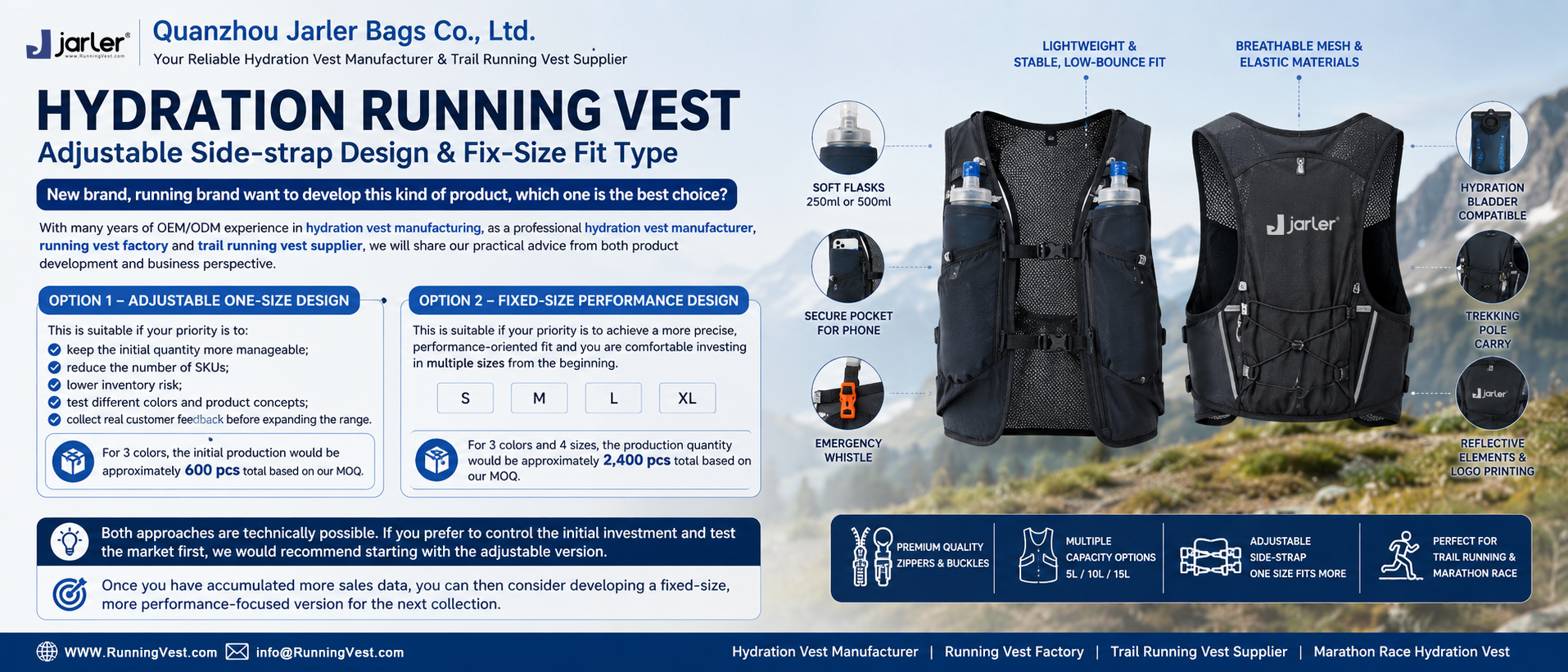
Option 1 – Adjustable One-Size Design
This is suitable if your priority is to:
- keep the initial quantity more manageable;
- reduce the number of SKUs;
- lower inventory risk;
- test different colors and product concepts;
- collect real customer feedback before expanding the range;
- keep cash flow more flexible.
Using our previous example, for three colors, the initial production would be approximately 600 pcs total based on a 200 pcs per model/color/size MOQ.
For many startup brands, this is the direction we would consider first.
Option 2 – Fixed-Size Performance Design
This is suitable if your priority is to achieve a more precise, performance-oriented fit and you are comfortable investing in multiple sizes from the beginning.
For three colors and four sizes, the production quantity would be approximately 2,400 pcs total based on the same MOQ example.
This strategy can make sense when you already have:
- reliable customer size data;
- an established running community;
- pre-orders;
- proven sales channels;
- sufficient development budget;
- enough volume to support multiple SKUs.
Another Strategy: Launch Adjustable First, Fixed-Size Later
The decision does not have to be permanent.
In fact, for many new brands, we believe a staged product-development strategy is more practical.
Collection 1
Develop an adjustable one-size hydration vest.
Use the first production to learn:
- customer chest-size distribution;
- preferred adjustment range;
- best-selling colors;
- preferred capacity;
- common complaints;
- phone-storage requirements;
- soft-flask preferences;
- real-world fit feedback.
Collection 2
Use this information to develop a more technical fixed-size version.
At that stage, your size chart is no longer based only on assumptions.
It is informed by actual customer data.
This can be a more gradual way to develop the product range while keeping the first launch relatively flexible and manageable.
Do Not Start With Appearance Alone
Today it is very easy for a startup brand to create a visually impressive running vest concept using graphic design software or AI-generated product images.
These tools are useful for communicating an idea.
But a concept image is not yet a manufacturing specification.
Before a trail running vest supplier can develop a reliable sample, the concept normally needs to be translated into actual requirements such as:
- body dimensions;
- target fit;
- chest adjustment range;
- capacity;
- fabric;
- mesh structure;
- pocket measurements;
- zipper lengths;
- soft-flask dimensions;
- phone dimensions;
- bladder requirement;
- trekking-pole position;
- reflective details;
- logo placement;
- trims and buckles.
A good manufacturing partner should therefore not simply copy an image.
The objective should be to understand the intended product and convert the visual concept into a construction that can actually be cut, sewn, fitted, tested and mass-produced.
What Information Should You Prepare Before Contacting a Running Vest Factory?
If you are approaching a running vest factory for the first time, you do not necessarily need a perfect technical pack.
However, giving the factory some basic information makes the development process much more productive.
At minimum, we recommend defining:
- Target customer
Road runner, marathon runner, trail runner, ultra runner or general outdoor user? - Target capacity
5L, 10L, 15L or another volume? - Fit type
Adjustable one-size or fixed size? - Hydration system
250ml soft flasks, 500ml soft flasks, hydration bladder or a combination? - Main storage requirements
Phone, keys, nutrition, jacket, trekking poles, bladder and other equipment. - Material direction
Lightweight, breathable mesh, elastic fabric, water-resistant areas or premium technical fabric. - Branding
Logo placement, reflective logo printing, colors, labels and packaging. - Expected order quantity
This is especially important because the design should make commercial sense at your planned volume.
The Cheapest Design Is Not Always the Lowest-Risk Design
Startup brands often compare quotations primarily by unit price.
Unit price matters.
But it should not be separated from:
- MOQ;
- tooling;
- sampling;
- number of sizes;
- number of colors;
- inventory requirement;
- development complexity.
For example, a fixed-size vest may have an attractive unit price.
But if producing four sizes and three colors increases your initial order from 600 units to 2,400 units, the total investment becomes very different.
For a new business, sometimes the better question is not:
“Which hydration vest is cheaper per piece?”
It is:
“Which development strategy lets us launch a good product while keeping enough cash and flexibility to improve the next version?”
That is a much more useful question.
Our Recommendation as a Hydration Vest Manufacturer
Both approaches are technically possible, so the final choice should depend on your product positioning and business stage.
If you prefer to control the initial investment and test the market first, we would normally recommend starting with an adjustable side-strap version.
Focus the first version on the things customers will immediately feel:
- lightweight construction;
- stable, low-bounce fit;
- breathable and elastic materials;
- comfortable mesh;
- secure phone storage;
- accessible soft-flask pockets;
- proper hydration-bladder integration if required;
- practical trekking-pole carrying;
- reliable zippers and buckles;
- reflective elements;
- sensible logo placement.
Once you have accumulated more sales data and understand your customers’ size distribution, fit preferences and best-selling colors, you can then consider developing a fixed-size, more performance-focused version for the next collection.
For many startup and growing running brands, this is a more controlled way to build a product range.
FAQ: Developing a Hydration Running Vest for a New Brand
Is adjustable one-size or fixed-size better for a new hydration vest brand?
For many first launches, an adjustable one-size design is easier to manage because it reduces SKUs, inventory requirements and size-distribution risk. Fixed sizes can provide a more precise performance fit but normally require more product-development work and greater inventory investment.
What is the difference between a running hydration vest and a normal backpack?
A running hydration vest is designed to sit close to the torso and move with the runner. Important characteristics include lightweight construction, breathability, elasticity, load distribution and a stable low-bounce fit. It usually provides fast access to hydration, nutrition and small equipment without removing the vest.
What hydration vest capacity is suitable for a first product?
A 5L hydration running vest can work well for road running, marathon training and shorter trail runs. A 10L vest provides more versatility for trail running, while 15L is better suited to longer trail and ultra-distance use where more equipment needs to be carried.
Should a hydration vest include 250ml or 500ml soft flasks?
It depends on the running application. A 500ml soft flask provides greater hydration capacity and is very common in trail running. A 250ml flask can be suitable for lighter running products, shorter distances or situations where lower weight is preferred.
Can a hydration running vest carry both soft flasks and a hydration bladder?
Yes. Many designs can be developed with two front soft-flask pockets and a rear hydration-bladder compartment. However, the added water weight should be considered during fit and bounce testing.
What features should a trail running vest include?
Common features include breathable mesh, elastic storage pockets, 250ml or 500ml soft-flask compatibility, hydration-bladder storage, secure phone pocket, trekking-pole attachments, reflective elements, an emergency whistle, premium-quality zippers and buckles, and a stable low-bounce construction.
What information does a hydration vest manufacturer need for OEM development?
Useful information includes the target runner, desired capacity, fit type, materials, pocket requirements, soft-flask or bladder requirements, logo placement, colors, approximate quantity and any reference products or concept drawings.
How should a startup choose a trail running vest supplier?
Do not evaluate a trail running vest supplier only on the lowest unit price. Also consider whether the supplier understands fit, pattern development, materials, pocket engineering, hydration systems, sampling, MOQ and the commercial realities of launching a new sports product.
Work With an Experienced Hydration Vest Manufacturer
Developing a hydration running vest is a combination of product design, pattern engineering, material selection, fitting and commercial planning.
For an established brand with significant sales history, developing multiple fixed sizes may be completely reasonable.
For a new running brand, however, reducing unnecessary complexity during the first launch can be equally important.
At Quanzhou Jarler Bags Co, Ltd., our role as a hydration vest manufacturer, running vest factory and trail running vest supplier is not simply to sew an existing drawing.
We believe the manufacturing side should also help customers evaluate whether the design, materials, fit structure, MOQ and production strategy make sense for the stage of their business.
If you are developing a 5L, 10L or 15L hydration running vest, marathon race hydration vest, adjustable running vest or fixed-size performance trail vest, a useful starting point is to define your target runner, expected quantity and most important use scenario first.
The product can then be developed around those real requirements rather than adding features simply because other brands have them.
For a first launch, keeping the product technically sound, commercially manageable and easy to improve is often more valuable than trying to make Version 1 solve every possible requirement.
Quanzhou Jarler Bags Co, Ltd.
OEM / ODM Hydration Running Vest Manufacturer
Running Vest Factory | Trail Running Vest Supplier