

Adjustable vs. Fixed-Size Running Vests: Why Established Brands and Emerging Labels Follow Different Product Strategies
In the trail running equipment market, there is a noticeable divide between the product strategies of leading international brands and new sports brands.
Many leading trail running gear brands like Salomon,Hoka,New Balance,Nike,Adidas, Patagonia, On One One, Kailas, offer their hydration running vests in several fixed sizes, such as XS, S, M, L and XL, often accompanied by multiple seasonal or permanent colorways. By comparison, new brands frequently enter the market with an adjustable, one-size-fits-most running vest and a much simpler color selection and black is the most popular one.
It reflects two very different stages of brand development.
Leading brands usually have the sales volume, customer data, distribution network and financial capacity required to support a complex multi-size product range. Startups with new brands, however, must prioritise flexibility, cash flow, inventory control and fast market validation.
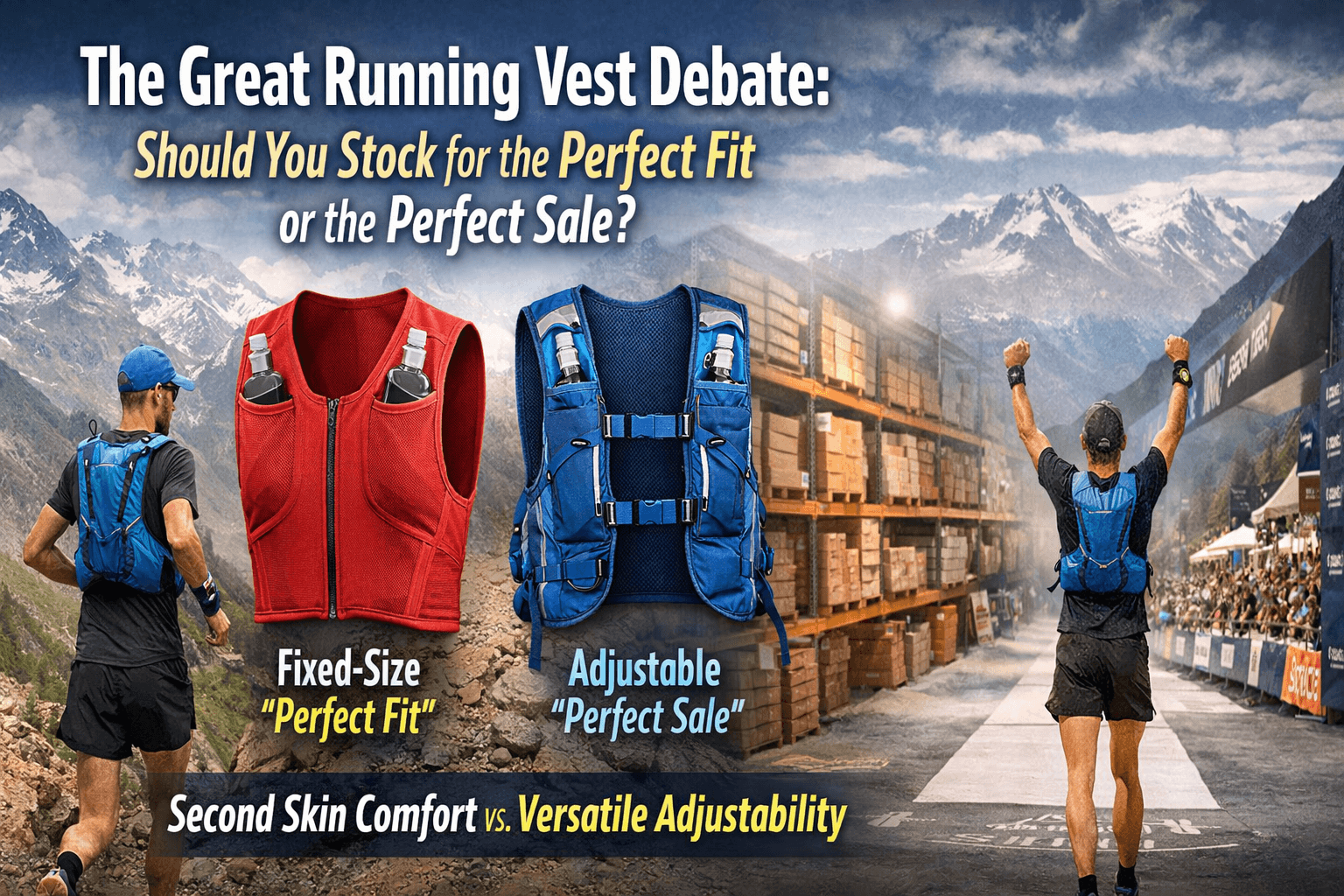
The choice between a fixed-size running vest and an adjustable running vest is therefore not only a design decision. It is also a decision about positioning, production economics, marketing and supply-chain capability and business risk.
Two Different Approaches to Running Vest Construction
Before examining the commercial reasons behind these strategies, it is important to understand the structural difference between the two product types.
Fixed-Size Running Vests
A fixed-size running vest is developed more like a fitted technical garment and apparel.
The product may be offered in sizes such as:XS/S/M/L/XL/XXL
Each size is based on a defined range of chest measurements, body proportions. Depending on the level of product development, the shoulder shape, vest length, pocket position, side-panel width and front-closure position may all be adjusted between sizes.
When properly developed, a fixed-size vest can provide:
- Closer body wrapping
- More accurate load distribution
- Reduced movement and bouncing
- More consistent soft-flask positioning
- Better pocket accessibility
- A more technical, race-oriented fit
However, every additional size creates another SKU that must be manufactured, labelled, stocked, distributed and replenished.
Adjustable Running Vests
An adjustable running vest normally uses side straps, elastic cords, webbing, buckles, hook-and-loop systems or other adjustment mechanisms to cover a broader range of body sizes.
Some models use one universal size, while others may be divided into only two general size groups, such as S/M and L/XL.
The main advantages include:
- Broader fit coverage
- Fewer SKUs
- Lower initial inventory investment
- Simpler size selection
- Easier online selling
- More flexible small-batch production
- Lower risk of unsold sizes
An adjustable vest may not provide the same individually graded fit as a highly developed multi-size race vest. Nevertheless, a well-designed adjustable model can still offer excellent stability, comfort and functionality for trail running, road running, hiking, marathon events and general outdoor use.
Why New Brands Prioritise Multiple Sizes
For major trail running brands, offering a full size run is not simply a matter of giving customers more choices. It is part of a broader performance and market-coverage strategy.
1. Precision Fit Is Part of the Product Promise
Performance brands often position a hydration vest as a technical extension of the runner’s body rather than merely a bag worn on the chest.
During long-distance trail running, small fit problems can become significant. Excessive movement may lead to:
- Chafing
- Shoulder pressure
- Uneven load distribution
- Soft-flask movement
- Difficult pocket access
- Restriction around the chest
- Increased bouncing on technical terrain
A fixed-size pattern allows designers to optimise the vest for a narrower body-measurement range.
For example, the position of the front flask pockets can be adjusted relative to the runner’s chest, while the back length can be coordinated with torso length. Shoulder curves, side-panel tension and front strap positions can also be graded according to size.
This level of anatomical optimisation is especially important for ultramarathon runners, competitive trail runners and athletes who expect the vest to remain stable over many hours of movement.
For these customers, “good enough for most people” may not be sufficient. They are often willing to spend more for a vest that feels almost custom-fitted.
2. Brands Have Reliable Customer Data
A mature brand normally has years of information from:
- E-commerce sales
- Retail stores
- International distributors
- Product returns
- Customer reviews
- Athlete testing
- Regional warehouses
- Previous product generations
This information allows the brand to estimate its size ratio more accurately.
It may know that certain sizes sell quickly, that a particular customer group needs a shorter torso construction, or that one market requires a different size balance from another.
This forecasting ability significantly reduces the risk of producing the wrong size mix.
A new brand usually does not yet have this information. Even when the total sales forecast is reasonable, it may not know how demand will be divided between S, M, L and XL.
The result can be an unbalanced inventory situation: Medium may sell out quickly while XS or XL remains in storage for months.
3. Large Sales Volumes Can Support More SKUs
In production planning, one style, one colour and one size generally form one SKU.
A vest offered in four sizes and three colours creates:
4 sizes × 3 colours = 12 SKUs
This is before considering men’s and women’s versions, special editions, accessories, regional packaging or different logo applications.
If a factory’s minimum order quantity is calculated separately for every size and colour combination, the required total quantity can increase very quickly.
For example, if a fixed-size model is produced in four sizes and two colours, it creates eight separate SKUs.
If the MOQ is 300 pieces per SKU, the total production quantity becomes:
4 sizes × 2 colours × 300 pieces = 2,400 pieces
A major brand may be able to absorb this volume across its global distribution network. It can allocate products to:
- Brand-owned websites
- Specialist running stores
- Outdoor retail chains
- National distributors
- Regional warehouses
- Marketplace channels
- Race events and sponsored teams
For a new label planning an initial order of 100 to 300 pieces, the same structure may be commercially unrealistic.
4. Larger Brands Can Carry More Inventory
A multi-size product line requires more than higher production volume. It also requires stronger inventory management.
The brand must maintain enough stock in each size and colour. Otherwise, customers may find that the vest is available in their preferred colour but not in the required size.
Established brands are more likely to have:
- Larger working capital
- Professional demand forecasting
- Warehouse-management systems
- Replenishment programmes
- Multiple sales channels
- Regional inventory allocation
- Dedicated purchasing teams
They can hold slow-moving sizes for longer periods and replenish fast-selling sizes when necessary.
For a young brand, money tied up in inventory may reduce the budget available for advertising, photography, product development, packaging, shipping and future production.
An adjustable model helps concentrate the investment into fewer SKUs.
Why Established Brands Offer More Colours
Colour is not merely decorative in the outdoor industry. It plays an important role in brand identity, merchandising, visibility and product renewal.
Major brands may use colour to:
- Build a recognisable seasonal collection
- Coordinate vests with footwear and apparel
- Create men’s, women’s or unisex product stories
- Introduce limited editions
- Support regional colour preferences
- Offer high-visibility safety options
- Refresh an existing product without changing its construction
- Encourage repeat purchases
A runner may already own a functional black vest but still purchase another version in a new seasonal colour.
For a mature brand, colour therefore becomes both a design tool and a marketing tool.
Large production volumes also make it easier to customise the colour of multiple components, including:
- Main fabric
- Stretch mesh
- Binding
- Webbing
- Elastic
- Zipper tape
- Buckles
- Reflective details
- Logo printing
- Labels and packaging
This allows an established brand to create a more complete and visually consistent colour story.
Why New Brands Favour Adjustable Running Vests
For a new running or outdoor brand, the priorities are usually different.
The initial objective is often to launch a commercially workable product, test customer demand and protect cash flow—not to offer the widest possible size and colour range.
An adjustable running vest is therefore often the more practical starting point.
1. Adjustable Designs Reduce SKU Complexity
Consider a fixed-size model offered in four sizes and two colours:
4 sizes × 2 colours = 8 SKUs
An adjustable model offered in two colours may create only:
1 size × 2 colours = 2 SKUs
This difference affects almost every part of the business:
- Factory MOQ
- Initial investment
- Barcode management
- Inventory forecasting
- Packing labels
- Website listings
- Product photography
- Warehouse organisation
- Replenishment
- Size exchanges
- After-sales service
For a new company with limited staff and capital, reducing eight SKUs to two can make the entire launch significantly easier to manage.
2. Adjustable Models Lower MOQ Pressure
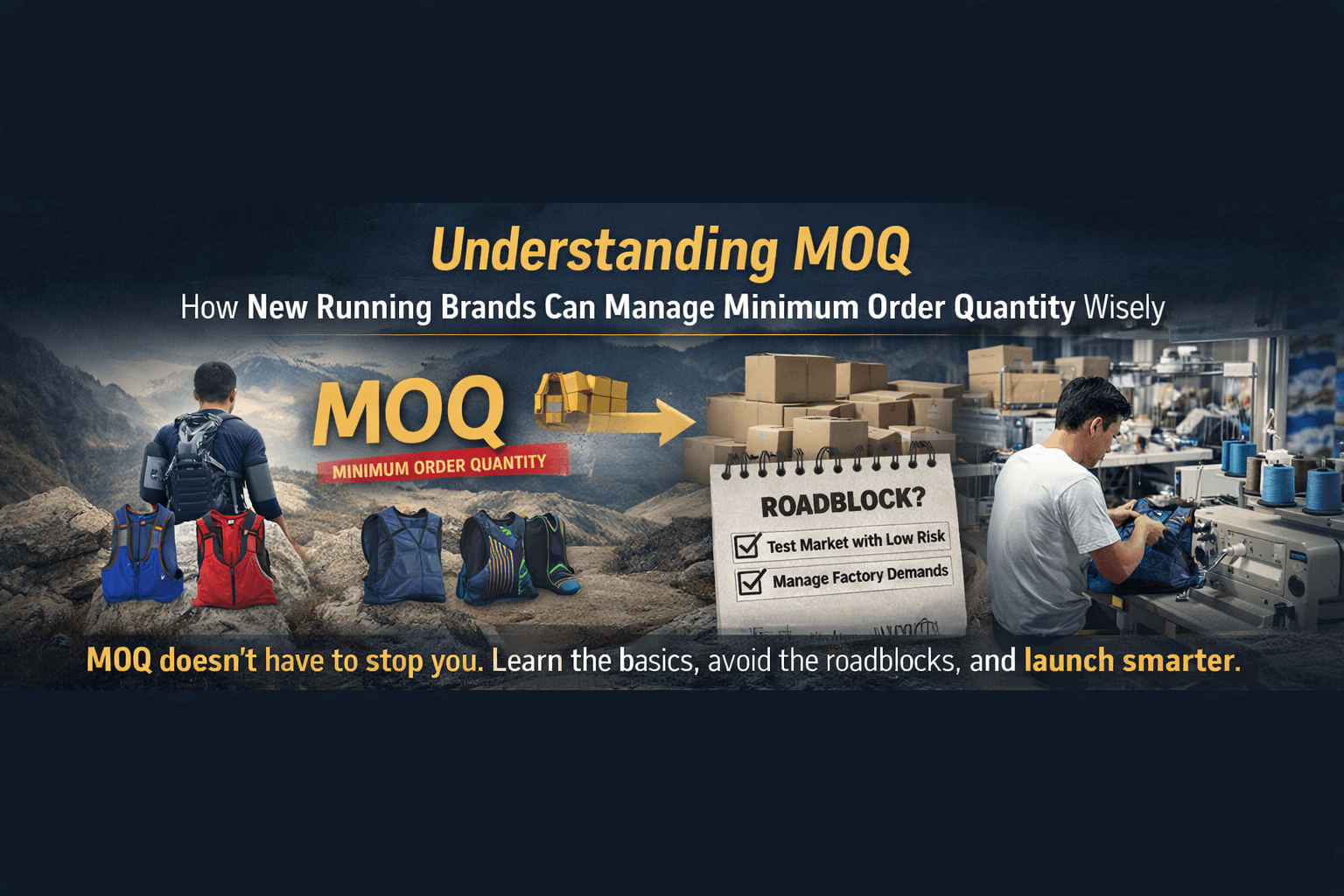
Many buyers initially focus only on the finished-product MOQ. In reality, running vest production is influenced by several layers of minimum order requirements.
Finished-Product MOQ
Factories need a minimum production volume to cover pattern preparation, cutting, machine adjustment, production-line setup, quality control and packaging.
Material MOQ
The suppliers of fabric, mesh, webbing, elastic, zippers, buckles and reflective materials may each have their own MOQ.
Colour MOQ
A custom colour may require separate dyeing for the main fabric, mesh, binding, webbing or zipper tape.
Size MOQ
Each size requires a separate cutting pattern and production allocation.
Process MOQ
Special printing, reflective transfer, custom moulded parts, woven labels and customised packaging may also have individual minimum quantities.
An adjustable model reduces the number of sizes involved, allowing more of the total order quantity to be concentrated into one production structure.
This makes it easier to meet factory and material requirements without creating excessive finished inventory.
3. Adjustable Designs Reduce the Risk of Unsold Sizes
One of the most common challenges for a new sportswear brand is choosing the correct size ratio.
Suppose a company orders:
- 20% Small
- 40% Medium
- 30% Large
- 10% XL
If actual demand is different, the company may sell out of Medium and Large while still holding a large quantity of Small.
The overall product may be successful, but the inventory remains commercially unbalanced.
An adjustable vest reduces this risk by covering a wider chest range with one structure.
This is particularly valuable when the brand:
- Has no previous sales history
- Is entering a new country
- Is selling mainly online
- Has a broad target audience
- Cannot accurately forecast customer measurements
- Is launching through crowdfunding or social media
4. Adjustable Vests Simplify Online Purchasing
Many emerging brands begin with direct-to-consumer channels such as Shopify, Amazon, social media or crowdfunding platforms.
Customers purchasing online cannot always try on the vest before ordering. A complicated size chart may increase hesitation, customer-service enquiries and returns.
A one-size-adjustable or two-size-adjustable system makes the decision easier.
This is also useful for:
- Running clubs
- Marathon organisers
- Corporate events
- Outdoor teams
- Promotional programmes
- Distributors testing a new market
- Wholesale buyers serving mixed customer groups
In these situations, the buyer may not know the exact measurements of every end user.
5. New Brands Often Prioritise Utility Before Anatomical Precision
Established performance brands frequently sell the experience of precise fit.
Emerging brands often begin by selling practical utility.
Their core customer promise may focus on helping runners carry:
- Water
- A mobile phone
- Energy gels
- Keys
- A lightweight jacket
- Basic safety equipment
In this context, adjustability can be presented as a positive feature.
The customer can tighten or loosen the side straps, adjust the chest position and adapt the vest according to clothing layers or load volume.
For recreational runners, beginners, running clubs and general outdoor users, this level of flexibility may be more important than a highly specialised race fit.
6. Adjustable Models Support Faster Market Validation
A new brand may still be testing:
- Target retail price
- Customer profile
- Colour preference
- Pocket layout
- Logo placement
- Bottle capacity
- Packaging format
- Advertising strategy
- Distribution channels
Launching multiple sizes and colours introduces too many variables at once.
An adjustable model with one or two colours allows the brand to enter the market with a more focused offer.
The first production run can then generate real information about:
- Best-selling colours
- Customer measurements
- Return reasons
- Fit complaints
- Preferred pockets
- Flask requirements
- Acceptable price points
- Most active customer groups
Future product development can be based on actual market feedback rather than assumptions.
The Hidden Challenge of Custom Colours
New brands are often attracted to fully customised colour combinations because colour helps communicate brand identity.
However, customised colours are not limited to the main body fabric.
A complete hydration vest may contain:
- Main stretch fabric
- Breathable mesh
- Pocket mesh
- Binding tape
- Webbing
- Elastic
- Zipper tape
- Buckles
- Plastic adjusters
- Reflective elements
- Sewing thread
- Heat-transfer logos
- Woven labels
Each component may come from a different supplier, and each supplier may have its own custom-colour MOQ.
Even when the main fabric can be dyed in a specific brand colour, matching every accessory may require enough material for several thousand finished products.
For smaller orders, standard accessory colours such as black, grey or white are usually more practical.
This is why many new brands begin with:
- One or two main colours
- Standard black or grey accessories
- A distinctive logo colour
- Stock fabric colour options
- Simplified packaging
This strategy still allows the product to look branded while avoiding unnecessary material investment.
Does Adjustable Mean Lower Quality?
No.
An adjustable running vest is not automatically a low-end product, just as a fixed-size vest is not automatically a premium product.
The final quality depends on factors such as:
- Pattern engineering
- Material selection
- Mesh elasticity and recovery
- Shoulder construction
- Seam strength
- Pocket design
- Zipper quality
- Elastic durability
- Strap positioning
- Load distribution
- Workmanship
- Quality inspection
- Wear testing
A poorly developed fixed-size vest may still bounce, restrict breathing or cause chafing.
A properly engineered adjustable vest can provide a secure fit, excellent breathability and practical storage while reducing the commercial risks associated with multiple sizes.
The correct structure depends on the intended user, sales channel, retail position and development stage of the brand.
A Common Development Path for Running Vest Brands
In practice, many successful running brands follow a gradual development process.
Stage One: Market Entry
The brand begins with:
- One proven adjustable structure
- One or two colours
- A broad fit range
- Custom logo
- Simple branded packaging
- A manageable initial quantity
The goal is to launch quickly, control inventory and collect real customer feedback.
Stage Two: Product Refinement
After the first production runs, the brand reviews:
- Customer body measurements
- Fit comments
- Product-return reasons
- Best-selling colours
- Pocket preferences
- Soft-flask preferences
- Price acceptance
- Regional demand
- Sales-channel performance
The adjustable design may then be improved, or the brand may introduce two general size groups.
Stage Three: Performance Segmentation
Once demand becomes stable, the brand may launch a more technical fixed-size model in S, M, L and XL.
At this stage, it is better prepared to determine:
- The correct size ratio
- Men’s, women’s or unisex sizing
- The number of commercially viable colours
- Regional inventory allocation
- Technical feature upgrades
- Premium material options
- Appropriate retail pricing
Stage Four: Full Product Collection
A mature brand may eventually operate several product families:
- Entry-level adjustable vests
- Multi-size race vests
- Long-distance hydration packs
- Women-specific models
- Lightweight competition models
- Seasonal colour collections
- Limited-edition products
The adjustable vest does not necessarily disappear. It may continue serving beginners, clubs, events, rental programmes or general outdoor customers while the fixed-size range serves more performance-oriented users.
Manufacturing Complexity Behind Multi-Size Products
From a manufacturing perspective, adding more sizes involves much more than enlarging or reducing the same pattern.
Depending on the product, each size may require adjustments to:
- Shoulder width
- Chest circumference
- Vest length
- Side-panel dimensions
- Pocket position
- Pocket opening
- Zipper length
- Elastic length
- Binding consumption
- Logo dimensions
- Front-strap position
- Carton assortment
The factory must also manage:
- Pattern grading
- Cutting markers
- Fabric consumption
- Bundle identification
- Size labels
- Care labels
- Packing labels
- Production-line separation
- Quality inspection
- Final carton ratios
More colours add another layer of complexity because materials and accessories must be separated and controlled throughout cutting, sewing, inspection and packing.
This explains why an existing adjustable model may support a relatively flexible starting quantity, while a completely new fixed-size and multi-colour design requires a much larger commercial commitment.
How Quanzhou Jarler Bags Factory Supports Different Brand Stages
As a professional trail running vest manufacturer, Quanzhou Jarler Bags Factory, we understand that a start-up label, an established outdoor company and an international performance brand do not have the same development requirements.
Instead of recommending the most complicated product in every situation, we help buyers select a cooperation path that matches their market stage, order volume and risk tolerance.
In-Stock Running Vests
Suitable for wholesalers, online sellers, clubs and buyers who want to test the market with a small initial order.
Blank Stock Models with Custom Branding
Suitable for brands that need a low starting quantity and want to add their own logo, hangtag or packaging without changing the main construction.
Existing Adjustable Models with Colour and Logo Customisation
Suitable for emerging brands that need:
- Broad fit coverage
- Fewer SKUs
- Lower inventory risk
- Custom branding
- Selected colour options
- Faster development
Existing Fixed-Size Models
Suitable for brands that require a more fitted product but do not want to invest immediately in an entirely new pattern.
Fully Customised OEM Running Vests
Suitable for established brands and well-prepared start-ups with:
- A complete technical pack
- Defined body measurements
- Clear size specifications
- Material requirements
- Detailed pocket construction
- Colour standards
- Target pricing
- Forecast order quantities
- A clearly defined retail market
Our objective is to help brands develop in stages—from low-risk market testing to more specialised, multi-size performance products.
Final Takeaway
The structural divide between established trail running brands and emerging labels is ultimately a reflection of business maturity.
Established brands tend to view the hydration vest as a precision performance instrument. They use multiple sizes to optimise fit and multiple colors to strengthen merchandising, identity and product segmentation.
Emerging brands tend to view the vest as an accessible and commercially flexible tool. They use adjustable structures to reach a broad audience while controlling MOQ, inventory, cash flow and market-entry risk.
Neither approach is universally superior.
A fixed-size, multi-colour product range makes sense when a brand has sufficient customer data, sales volume, capital and distribution capacity.
An adjustable running vest makes sense when a brand needs to launch efficiently, serve a broad customer base and validate demand before committing to a larger and more complex product line.
The smartest product strategy is not to copy the structure of the largest brands immediately. It is to select the structure that matches the brand’s current capabilities and allows the product range to evolve alongside the business.
For many emerging running brands, an adjustable vest is not a compromise. It is a disciplined first step towards building a more complete and technically specialised product collection.