

 Understanding MOQ for Custom Bags: A Practical Guide for Hydration Vests, Sports Bags, Running Belts, and Hydration Backpacks
When developing a custom bag product, one of the first questions buyers usually ask is:
What is your minimum order quantity?
The answer is not always as simple as giving one fixed number.
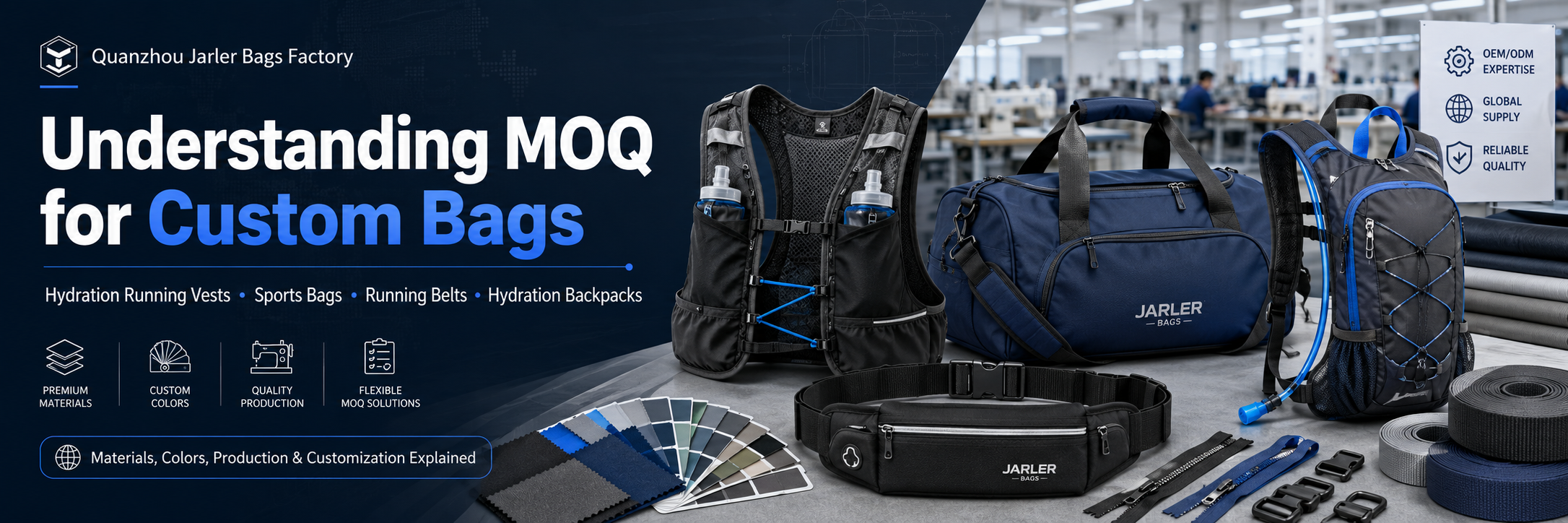
For products such as hydration running vests, sports bags, running belts, hydration backpacks, and other custom outdoor bags, the final minimum order quantity depends on several factors, including the product structure, materials, colors, components, customization level, and raw material availability.
At Quanzhou Jarler Bags Factory, we believe that buyers should understand not only what the MOQ is, but also why it exists and how different material and color choices can affect the final production quantity.
This guide explains the main factors behind MOQ requirements and introduces several practical solutions for brands planning a new custom bag project.
What Does MOQ Mean in Sports & Outdoor Bag Manufacturing?
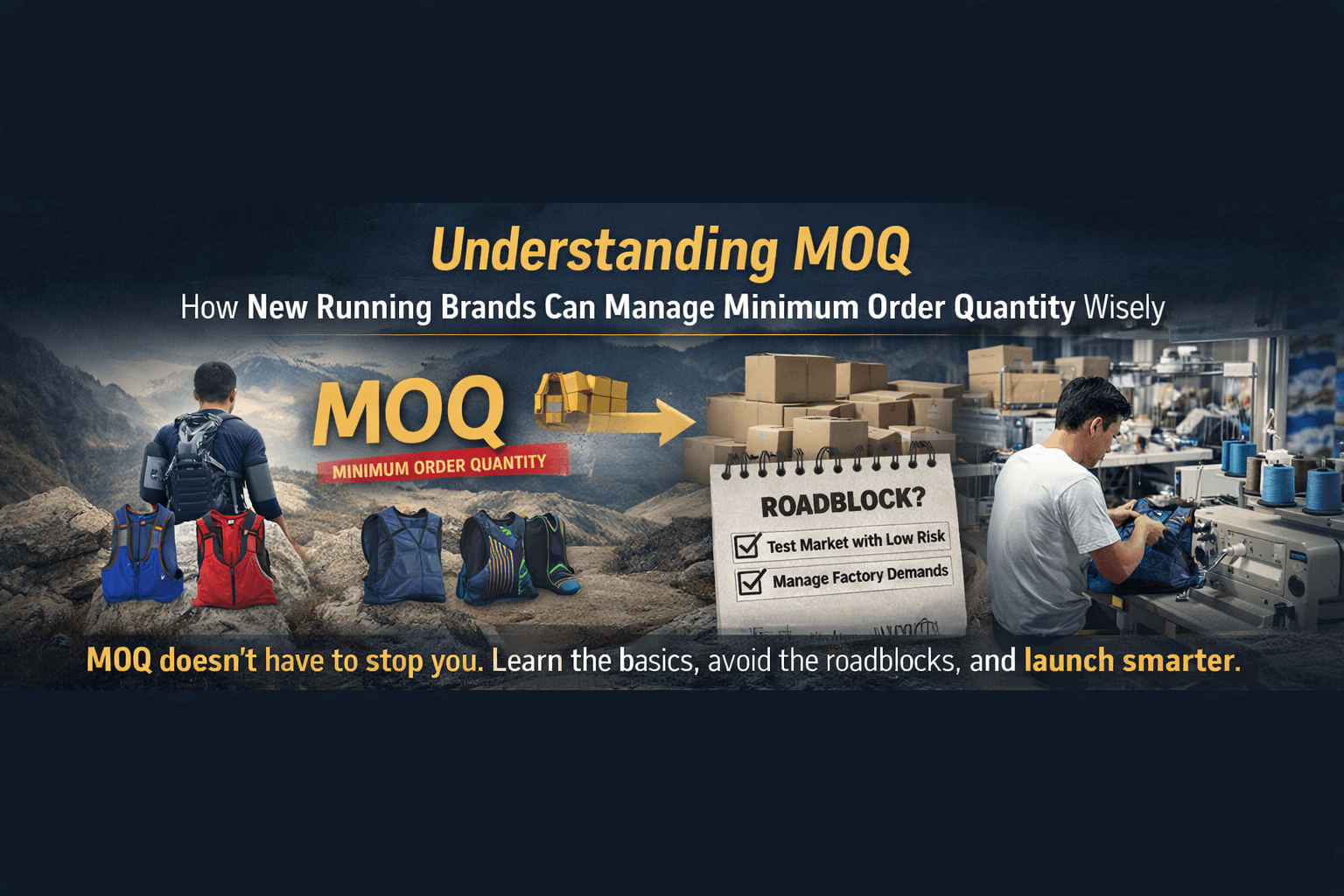
MOQ stands for minimum order quantity. It is the smallest quantity that a factory can normally produce under reasonable manufacturing and cost conditions.
For most custom bag products, the standard MOQ is generally calculated per style and per color.
For example, if a customer orders the same hydration running vest in black and blue, each color may need to meet the required MOQ separately.
As a specialized hydration running vest manufacturer,Quanzhou Jarler Bags Factory, we set the regular production MOQ for many custom bag products to be approximately 100 to 200 pieces per style and color, provided that existing stock materials and standard colors can be used.
However, this quantity may change depending on the design, construction, materials, accessories, and color requirements.
Why Does a Bag Factory Need a Minimum Order Quantity?
Bag manufacturing involves many preparation and production steps.
Whether we produce 30 pieces or 3,000 pieces, the factory still needs to arrange:
- Pattern development
- Material preparation
- Cutting
- Printing or logo application
- Sewing
- Assembly
- Quality inspection
- Packing
A hydration running vest or running belt, for example, may include breathable mesh, stretch fabric, elastic bindings, adjustable chest straps, zippers, buckles, reflective trims, soft-flask pockets, hydration water bladder compartments and several storage compartments.
A hydration backpack may require even more components, such as shoulder straps, back padding, hydration bladder compartments, hose openings, compression straps, webbing, buckles, and multiple zipper pockets.
These processes require production setup, workers, machines, quality control, and management time.
If only 20 or 30 units are produced, the same fixed preparation costs must be divided among a very small number of products. As a result, the unit cost becomes extremely high.
This is why a factory MOQ is necessary. It helps ensure that the production process remains technically practical and economically reasonable.
Finished Product MOQ Is Only Part of the Story
Many buyers assume that the factory determines the entire MOQ.
In reality, raw material suppliers often have a greater influence on the final order quantity.
A sports bag or running belt may use several different materials and components, including:
- Main fabric
- Lining fabric
- Mesh
- Zippers
- Webbing
- Elastic bands
- Buckles
- Plastic hardware
- Metal accessories
- Reflective materials
- Labels
- Packaging materials
Each supplier may have its own minimum order quantity.
The amount of each material used in one product is also different. This means that the same material MOQ may support very different quantities of finished products.
How Raw Material MOQ Affects the Final Order Quantity
Suppose a custom hydration backpack uses approximately 0.6 yards of main fabric per piece.
If the fabric supplier requires a minimum order of 1,000 yards for a custom-dyed color, that quantity may be enough to produce approximately 1,500 backpacks.
Now consider the buckles.
If each hydration backpack requires two pairs of buckles and the buckle supplier requires a minimum order of 5,000 pieces, the buckle MOQ may support approximately 2,500 finished backpacks.
The zipper supplier may require 1,000 yards of a custom-colored zipper. If each backpack uses only 0.2 yards, this amount may support approximately 5,000 finished products.
These examples show why the raw material MOQ is often the real production bottleneck.
The fabric MOQ, zipper MOQ, buckle MOQ, webbing MOQ, and accessory MOQ are rarely the same. The final production requirement is often influenced by the material with the highest minimum order threshold.
Product Structure Also Influences MOQ
Different bag products have different levels of construction complexity.
Hydration Running Vests
Hydration running vests are normally made from several lightweight and stretchable materials. A typical vest may include breathable mesh, elastic binding, stretch pockets, zippers, chest straps, buckles, reflective trims, and soft-flask holders.
Because the product combines many different components, custom colors across all materials may significantly increase the material MOQ.
Using standard black mesh, black zippers, and stock buckles can help keep the order quantity lower.
Sports Bags
Sports bags may include duffel bags, gym bags, team bags, training bags, shoe compartments, wet compartments, and multiple carry options.
The MOQ depends heavily on the main fabric, lining, zipper size, handle webbing, shoulder strap hardware, printing method, embroidery, and internal structure.
A simple stock-fabric sports bag may be produced at a lower MOQ, while a fully customized sports bag with exclusive colors and branded hardware may require a much larger material commitment.
Running Belts
Running belts usually require stretch fabric, elastic materials, zippers, buckles, reflective logos, and sometimes bottle holders or pole attachments.
Although running belts are smaller than backpacks, their material consumption per unit is also lower. This means one roll of fabric or one batch of custom-colored elastic may support a very large number of finished running belts.
For this reason, a special custom color may create a surprisingly high raw material MOQ even though the product itself is small.
Hydration Backpacks
Hydration backpacks normally have more structured construction than hydration vests. They may include padded shoulder straps, back panels, hydration bladder sleeves, hose ports, compression systems, multiple compartments, mesh pockets, buckles, and adjustable webbing.
The more materials and components involved, the more likely it is that one custom element will raise the overall MOQ.
Standard Colors Are the Best Choice for Lower MOQ
For most bag projects, black, white, grey, and other common market colors are easier to source.
Material suppliers usually keep these colors in stock because they are widely used across hydration packs, running vests, sports bags, backpacks, waist bags, and other outdoor products.
When standard stock colors are available, there is normally no need to meet a separate raw material MOQ.
In this situation, production can usually follow the factory’s finished product MOQ, which may be around 200 to 300 pieces per style and color, depending on the product.
This is often the most practical solution for new brands, trial orders, and market testing.
Using Existing Supplier Color Cards
If a customer does not want black, grey, or another standard color, we can first check the available color cards from our material suppliers.
The supplier may already have similar colors in stock, such as navy blue, olive green, khaki, red, orange, purple, or light blue.
At Quanzhou Jarler Bags Factory, we normally recommend selecting the closest available stock color before considering custom dyeing.
This approach offers several advantages:
- Lower MOQ
- Lower initial investment
- Faster material sourcing
- Less excess material
- Lower inventory risk
- Easier trial production
For example, if a brand wants a cyan hydration running vest, we may first search the supplier’s stock color card for the closest available blue tone.
If a suitable color is available, the buyer may avoid the high MOQ required for custom dyeing.
However, stock colors also have one limitation.
The same color may not always be available for the next order. The supplier may sell out, discontinue the color, or provide a new batch with a slight shade difference.
For first orders or market testing, this is usually acceptable. For brands requiring long-term color consistency, a custom material solution may be more suitable.
Special Custom Colors and Pantone Matching
Some brands require exact Pantone colors or exclusive brand colors.
This is common for sports brands that want the fabric, zipper, elastic, webbing, binding, and accessories to follow a consistent brand identity.
If the requested color is not available from stock, the material supplier must arrange custom dyeing or special production.
Custom colors may involve:
- Lab dip development
- Color approval
- Dyeing charges
- Minimum fabric quantities
- Minimum zipper quantities
- Minimum webbing quantities
- Minimum elastic quantities
- Custom plastic or metal accessories
- Possible molding charges
Each component may need to be developed separately.
Even if the customer only wants 300 hydration backpacks, the materials may need to be purchased in quantities sufficient for 1,500, 2,500, or even 5,000 finished products.
This does not always mean the buyer must produce all finished products immediately. It means the raw materials must be purchased according to the supplier’s minimum quantity.
Two Practical Solutions for Custom Colors
To help customers control costs and reduce initial risk, Quanzhou Jarler Bags Factory normally offers two main solutions.
Option 1: Use the Closest Available Stock Colors
Under this option, we select the closest matching colors from our suppliers’ existing stock materials.
For example, the customer may select:
- One available fabric color
- A matching or similar stock zipper color
- Standard black or grey buckles
- Existing webbing colors
- Standard black mesh
This solution is particularly suitable for:
- New brands
- Trial orders
- Small product launches
- Crowdfunding projects
- Running clubs
- Race events
- Retail market testing
The main advantage is that the customer can normally produce according to the finished product MOQ without purchasing excessive materials.
The disadvantage is that future orders may have slight color differences or may require a replacement color if the original stock is no longer available.
Option 2: Purchase Custom Materials and Store the Balance
If the customer requires exact colors and consistent future production, we can purchase the materials according to the suppliers’ minimum quantities.
We first use part of the materials to produce the customer’s current order, such as 300 hydration running vests or 500 sports bags.
The remaining materials can be stored for future orders.
In Quanzhou Jarler Running Bags Factory, we can normally provide free storage for the remaining custom materials for up to six months, subject to the specific project agreement.
These materials may then be used for:
- Repeat orders of the same product
- New products in the same color series
- Matching hydration backpacks
- Coordinated running belts
- Related sports bags
- Future seasonal collections
For example, a brand may first produce a hydration running vest in a custom green color. The remaining fabric, webbing, and zipper materials may later be used to develop a matching running belt or hydration backpack.
This helps distribute the material cost across several orders and product categories.
The main advantage is better color consistency for future production.
The main disadvantage is that the customer must invest in more materials at the beginning and accept the financial and inventory risk associated with unused materials.
Which MOQ Solution Is Best for a New Brand?
For most first-time buyers, we recommend starting with existing materials and stock colors.
This is especially suitable when developing:
- A first hydration running vest
- A new running belt
- A small sports bag collection
- A trial hydration backpack
- A new private-label outdoor product
The purpose of the first order is usually to test the market, collect customer feedback, confirm sizing, evaluate product performance, and improve the design.
At this stage, it may not be necessary to invest heavily in fully customized colors across every material and accessory.
Once sales become stable, the brand can move to custom-dyed materials and build a more consistent product color system.
How to Reduce MOQ for a Custom Bag Project
Buyers can often reduce MOQ by making several practical decisions.
First, choose existing stock materials instead of custom-developed materials.
Second, use standard colors for secondary components. For example, a hydration vest may use a custom-colored main fabric together with black mesh, black zippers, and black buckles.
Third, avoid custom-molded hardware during the first order. Existing buckles and accessories are usually more cost-effective.
Fourth, use standard logo methods such as heat-transfer printing, screen printing, woven labels, or embroidery instead of developing custom hardware.
Fifth, limit the number of colors and sizes in the first production run.
For example, ordering 300 units in one color is usually more practical than dividing 300 units into six different colors.
Finally, use the same materials across several related products. A matching hydration vest, running belt, and sports bag collection may help consume custom materials more efficiently.
MOQ Is Not Only About Quantity
MOQ is also connected to quality, consistency, production efficiency, and long-term cost control.
An unrealistically low production quantity may create several problems:
- Higher unit cost
- Greater material waste
- Inconsistent production
- Difficulty sourcing matching components
- Higher labor cost
- More production interruptions
- Reduced supplier support
- Increased risk of color differences
A reasonable MOQ allows the factory to arrange the production line properly, control quality, purchase materials efficiently, and offer a more competitive unit price.
How Quanzhou Jarler Bags Factory Supports Custom Projects
Quanzhou Jarler Bags Factory supports OEM and ODM development for a wide range of sports and outdoor bag products, including:
- Hydration running vests
- Trail running vests
- Hydration backpacks
- Running belts
- Sports bags
- Gym bags
- Waist bags
- Outdoor backpacks
- Soft-flask-compatible running gear
- Custom branded accessories
Our team can evaluate your design, product structure, target quantity, materials, colors, branding, packaging, and expected budget before recommending the most suitable production solution.
Rather than simply giving an MOQ number, we help customers understand which elements are increasing the quantity and how the design can be adjusted to reduce unnecessary cost.
Information Needed for an Accurate MOQ Evaluation
To evaluate your project accurately, it is helpful to provide:
- Product photos or reference samples
- Technical drawings or tech packs
- Required dimensions
- Estimated order quantity
- Number of colors
- Required sizes
- Fabric requirements
- Pantone colors, if applicable
- Logo artwork
- Printing or embroidery requirements
- Zipper and buckle preferences
- Packaging requirements
- Target market
- Target price range
Based on this information, we can determine whether stock materials can be used or whether special material production is required.
Final Thoughts
The MOQ for hydration running vests, sports bags, running belts, and hydration backpacks is not determined by one single rule.
It is the result of several connected factors:
- Factory production setup
- Product complexity
- Raw material availability
- Material supplier MOQ
- Color requirements
- Accessory requirements
- Order quantity
- Future repeat-order plans
For lower-risk trial orders, using standard or available stock colors is normally the most practical option.
For established brands requiring strict color consistency, purchasing custom materials and storing the remaining balance may offer better long-term value.
At Quanzhou Jarler Bags Factory, our goal is to help customers find the right balance between product quality, MOQ, customization, cost, and inventory risk.
A well-planned MOQ strategy does not only reduce the initial cost. It also makes future product development, repeat orders, and collection expansion much easier.